How are your metals weighed at Brisbane Metal Recycling?
Have you ever loaded a lot of scrap into the trailer and then wondered what happens when you get there? What do they use to weigh it? What grade do they give it? How do you know you're going to get the right price? That's what Weigh-In Day is all about. There's absolutely no mystery as to how the process works at Brisbane Metal Recycling for you – we'll weigh your metal, assess the grade, segregate it and then work out exactly how much you'll get. It's not as simple as just stepping on the scales and walking away with your money. That knowledge will help you to pick the process you want to use when you're loading, will help you to sort your scrap more efficiently and will help you to avoid any surprises when you get there. Let's have a look at what's going on bit by bit.
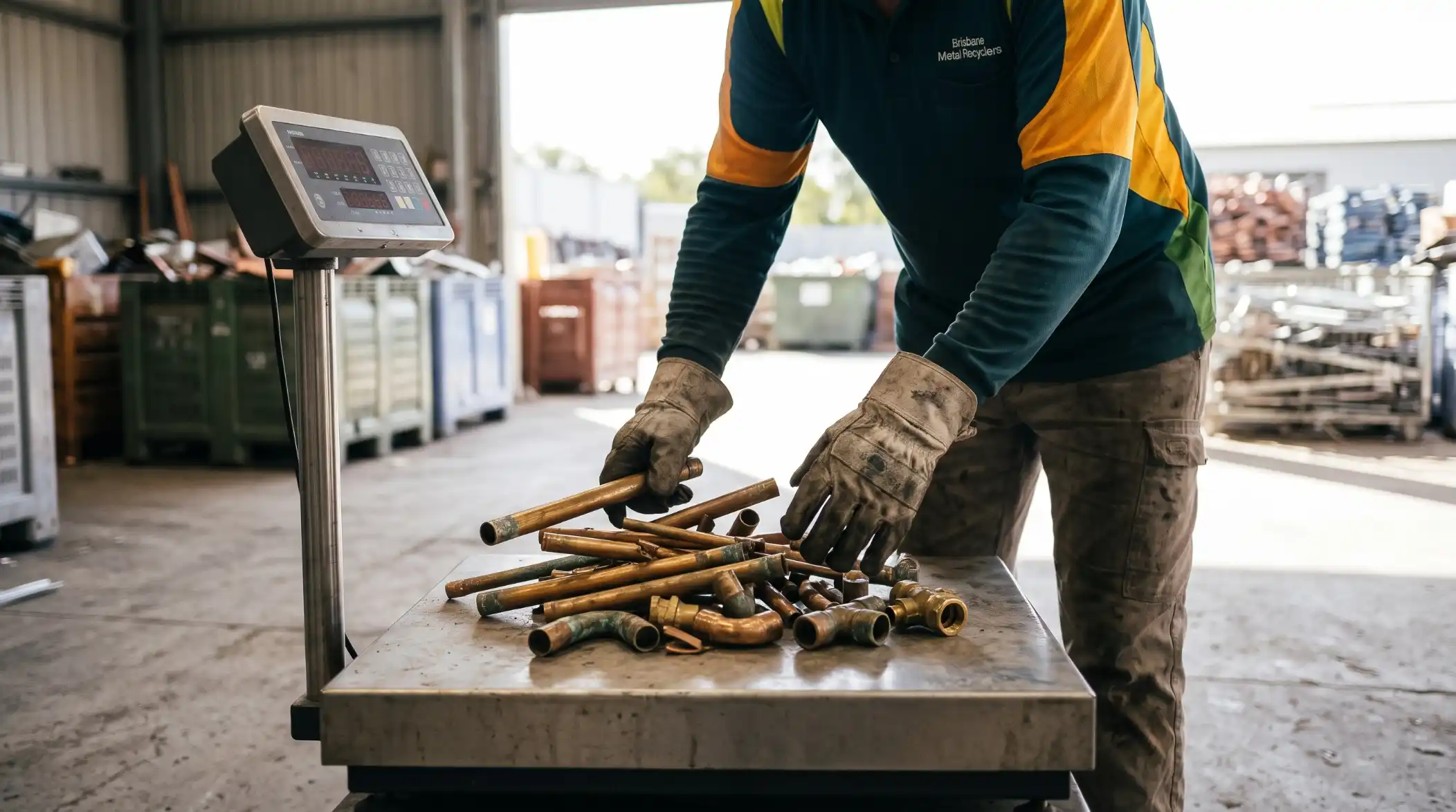
Preparation Before You Go
You're going to need to do a bit of preparation before you go. The best bit is when your scrap load is being prepped. Separate out the different types of scrap you've got (steel, copper, aluminium and brass) before you even get there and it really does make your life so much easier. It makes it far easier to grade the scrap and ensures that the high value scrap doesn't get muddled in with the lower value stuff. The first and easiest thing to start with is a magnet. Most of the time, it's a ferrous metal (i.e. it contains steel or iron) if a magnet sticks to it. If it doesn't stick, then it's probably a non-ferrous metal. The non-ferrous metals that are most commonly used are aluminium, copper, brass and some stainless steels. It's an easy test which will allow you to rule out most of the metal you're likely to come across in your home, barn or workshop.
Remove all the unnecessary plastic, rubber and the like.
Wherever possible, peel off the plastic handles, the tyres, the wirework and the foam from old dryers, old lawnmowers and old bike frames (the list could go on). Stripping away all that extraneous material can make the sorting of the metal a lot easier and therefore a lot more worthwhile. Just a quick reminder: If you're at all in any doubt as to whether any of the items you have are going to be okay to take in, don't try to take them apart. Be very careful with gas bottles and all other pressurised containers. Always ask and always call if you're in the slightest bit unsure as to whether you're able to bring it in.
It's useful to have a photo ID with you.
The QLD scrap metal dealers law requires them to keep a record of all their transactions, so you may well need to produce a photo ID when you go to sell your metal. It's best to have it to hand so you can get on with the job.
Stage 1 – Arriving at the Yard
The first step is arriving at the Yard. Brisbane Metal Recycling is an active industrial waste recycling operation and safety is our number one priority. When you get there, make sure you follow any signage and directions from our staff. There is a traffic route through the yard, so please make sure you follow that. Slow down, watch the road, and follow staff instructions. Keep children and pets in your car or at home. Before you drive onto the weighbridge, the weighbridge staff will ask you what you're bringing in. You don't need to know the technical specs and grades of each metal, just a general description. For example: A consignment of domestic scrap of various types (steel, some aluminium and a few copper pipes). This helps us get ahead of things and get a better idea of how to handle your gear. Also bear in mind if you've got anything on you that's been in oil or may have been in refrigerant. We're not trying to put you on the spot in any way whatsoever; we just need to note that. We're doing it in a safe and effective manner.
Stage 2 – Weighing Your Scrap and Vehicle
Stage two is weighing your scrap and vehicle. The weighing machine is now in use.
What is a weighbridge?
A weighbridge is a large scale built into the ground. It doesn't weigh your metal at all; it weighs your vehicle and trailer. In the course of this process, you will hear three words:
- Gross weight is the weight of your car and trailer when they're loaded up with a full amount of scrap metal.
- Tare weight is the weight of the vehicle and trailer once all the scrap has been removed.
- Net weight is the total weight of the scrap metal on offer for sale.
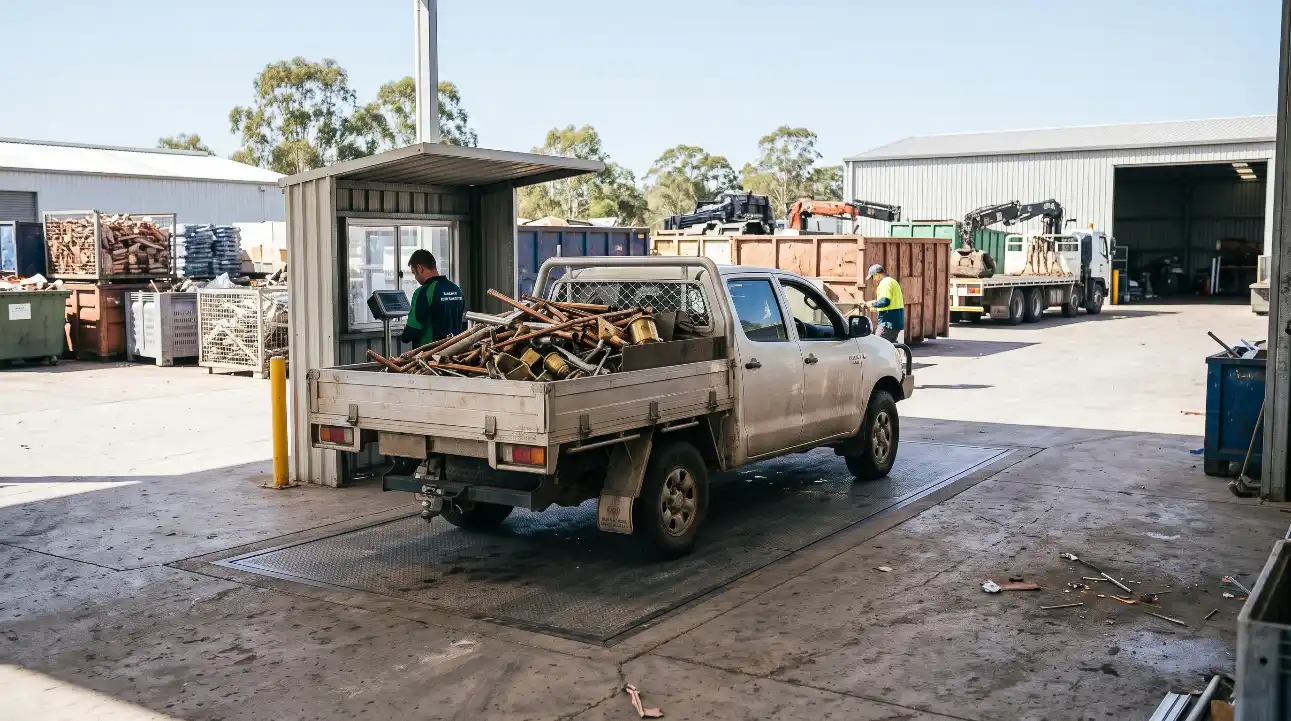
Let's weigh the complete vehicle. That gives us the full weight. Then you'll empty the scrap metal and cross the weighbridge again. The tare weight is the weight of your vehicle and trailer at this point. The weight that is subsequently calculated is the NET weight and is equal to the gross weight less the tare weight. It's easy to do the math: Gross Weight - Tare Weight = Net Weight For instance, if you're weighing 3,500kg with the vehicle loaded and 2,800kg empty, then your scrap metal is 700kg. The process is not an estimate; it's measured using a calibrated weighbridge. If you're interested, you can also note your gross weight when you get to the yard and your tear weight when you leave, and then check the difference yourself. Not every load needs to go on a weighbridge. Smaller quantities (e.g. a boot full of copper pipe, or a handful of bags of aluminium cans) can be weighed on one of the smaller scales. The principle is the same though. You weigh the metal, you note the weight and you use that to work out your payment. All weights are in kg. Most scrap metal prices are per kg, but if you're buying a large quantity of industrial scrap, it may be sold by the tonne.
Stage 3 – Grading Your Metal
This is where it all becomes interesting. No matter what metal you're looking at, not all scrap metal is the same. Take two lots of copper for instance. One could be a lot more expensive than the other purely on the basis of its condition, its purity and what it actually contains.
What is grading?
Grading is the process of establishing the genuine identity of the metal you have and working out what grade it is. We work with all sorts of metals every day at the yard. After all the years of experience, we can pick the grades apart quite easily. They'll look at it in a number of ways: the colour, the weight, the thickness, the condition of it, etc. They may well do some further tests on it if they need to, for instance, use a magnet. Some metals look very much the same but are worth a very different price, so it is important to be able to tell them apart. Let's look at a couple of fairly common examples.
Copper
There are various grades of copper. Painted or soldered pipe (or copper with the fittings on) won't generally command the same prices as clean copper pipe with no paint at all. Another example is insulated copper wire. It's a plastic-insulated product and therefore has its own grade, so it would be nonsense to compare it to clean copper. Others may be rated quite differently as copper-coated products.
Brass
Brass is a copper and zinc alloy. It may contain copper, but it is a different metal grade, so it is charged as such.
Aluminium
It could be aluminium, cast aluminium, aluminium cans or clean extrusions. Not all of these are necessarily going to be tested, and it may be worth keeping the various materials separate.
Steel & Iron
Steel and iron are also materials you'd normally find at a scrap yard. They're generally cheaper per kg than other non-ferrous alloys like copper and brass. They can still be fairly expensive materials to use in large quantities, though. Different grades of steel are also available. Steel that's heavily contaminated or mixed will of course take longer to process than clean, thick and solid steel.
Stainless Steel
Sometimes people confuse stainless steel with ordinary steel. If you're using the magnet test to identify stainless steel, there's one thing you should be aware of. Not all stainless steel is magnetic. We can also use other additional checks to clearly identify the stainless steel and thus put it into the correct grade.
How do grade differences affect your metal?
After a couple of visits to the yard, you'll start to make observations and begin to see a few patterns. Your scrap grade can be impacted by three things.
1. Cleanliness
Sorting is easier with clean metal. You can simply trim off the excess plastics, rubber, fittings, etc., which will then qualify it for a lower grade. This is down to the time it takes to both isolate the contaminated material and then clean it.
2. Mixed Materials
Mixing the different metals together makes it much harder to identify and recover the precious metals. For example, if you've got a trailer load of steel with some copper pipework mixed in, the copper can be harder to find when you're grading. You don't need to sort each piece to the finest degree; it's worth trying to separate out the copper and brass, as these are the most valuable metals.
3. Thickness & Condition
The grade may also be determined by the metal's thickness, density, and overall general condition. The surface treatment of the material (rust, coating, paint, etc.) will affect how the material is processed and what category it ends up in. I can assure you these aren't reasons why your metal is unsuitable. These are just the factors that we look at in relation to the whole pile.
Stage 4 – Sorting Your Scrap
Then, at step 4, you can sort your scrap to focus on the more valuable materials. After weighing and classifying the metal, it should be placed in the appropriate bay/storage area. Sorting: it may not seem the most important role in the world, but it is. The various metals have to be separated out as each is going to be sold on to a processing plant or a metal mill. There's a requirement for the continual addition of the specified materials to those plants so that they can be melted down and re-melted into a new product. A tonne of 'pure' aluminium is worth a hell of a lot more than a tonne of aluminium contaminated with steel and other stuff. Good sorting maintains the quality and ensures it gets to the right place. This is another good opportunity to learn for next time. Pay close attention when you're looking at your scrap being taken to a particular bay and if you see anything that shouldn't be there, write it down. The more you know about the way the scrap is graded, the better prepared you'll be for the next load.
Larger Items
This is for larger items which can be moved to a site where we can use larger plant. This would be things like car bodies, used water tanks, and the like. However, further sorting will be required for other complex products such as motors, electric motors, electrical goods, etc. to separate out the various metal components.
Stage 5 – Knowing What Your Scrap Is Worth
Once you've established the weights and grades, you can work out the value of your load. The maths is trivial. You take the net weight of each grade of metal and multiply that by the current price for that grade per kg. You'll then have three separate calculations if you've got three different grades. Add those together to work out the total payment amount. Suppose you have a load that contains:
- 120 kg of uncontaminated steel
- 8kg aluminium
- 3kg of copper
The materials are sold on a piece-and-grade basis and purchased at market rates. The key thing to bear in mind is that scrap metal prices are always in flux. The rest of the world metals market is based on supply and demand, currencies and the willingness of the processors and mills to take the metal. That's why the price you're being paid today could be different from the price you were paid the last time you came in. Copper is a fluctuating commodity, so it's always worth checking current prices before you go and load your trailer. The best way to get a feel for what you'll be paid is to just call Brisbane Metal Recycling before any actual work commences. In addition, you need to get a feel for how your payment is calculated. The weights, the numbers and the grades that go into your bill need to be laid out in your docket. Ask if you don't understand. The scrap yard will be more than happy to walk you through how your metal was weighed, graded, and priced. It'll be a lot easier if you know what the payment comprises.
Stage 6 – Getting Paid
Once you've finished weighing, grading, and calculating your metal, you're all set for payment. This will depend on the requirements of the relevant scrap metal dealer and the nature of the transaction. Call to confirm which payment methods they accept. You'll also need to keep a log of the transaction. Small business owner? Have a job or two? Your docket is a fantastic record to keep if you're a scraper, a tradie, or a landlord. The file must contain details such as:
- The date of the transaction.
- The weights recorded.
- The grade of the metal being sold.
- The total amount paid.
These records make it much easier to keep your business paperwork and track your scrap sales.
How on Earth Does It Work Like That?
The reason for each step in the weigh-in process is as follows:
- A good weighing scale will of course enable you to weigh the metal you're selling.
- Grades dictate the type and quality of metal and hence what it can be sold for.
- Sorting enables the processing of the various materials by separating them.
- Keep a record of what happens. That's a record you can both keep.
But there's also a bigger picture. One tonne of recycled metal is one tonne of metal that you don't have to mine and manufacture again. Every metal (steel, aluminium, copper, etc.) can be recycled and made into something else. It could be the old trailer load from a building alteration, the old appliances in your shed or the leftover building supplies from a renovation; it could all be raw material again. Recycling scrap metal is an essential part of the continuing effort to keep those materials moving through the economy and to reduce the use of raw materials.
Some Tips for a Successful Weigh-In Day!
A bit of preparation and your trip won't be so bad at all and you'll get the most out of your scrap. What we recommend you try:
- Before you even go out the door, find your metals. Work out which of your metals are ferrous and which are non-ferrous using a magnet.
- Deposit the valuable metals separately. Don't mix the copper and brass into your steel charge.
- Drop the Plastics and Rubber if you can. Only do it if you can and if it's safe.
- Photo ID. You'll need to provide your photo ID if you're selling scrap metal in Queensland.
- Buy in bulk if these are the lowest prices. Give us a call and see if you've got any metal that's worth a penny at all!
- Unload easily. Be tactical and ready for the metal removals.
- Dress appropriately really. It's always a good idea to have appropriate footwear and gloves on when you're working with scrap metal.
Doing it all in the yard makes grading a doddle.
Come and See for Yourself!
The easiest way to learn how Weigh-In Day works is to go through it yourself. If you've got a lot of scrap metal piling up in your garage, backyard or shed, then bring it in to Brisbane Metal Recycling to get it off your hands. You will see how the weighbridge is used, how your metal is assessed and classified, and how you will be paid.
Wondering whether rust, paint or dirt changes the grade? See how rusty, painted and dirty scrap is valued.